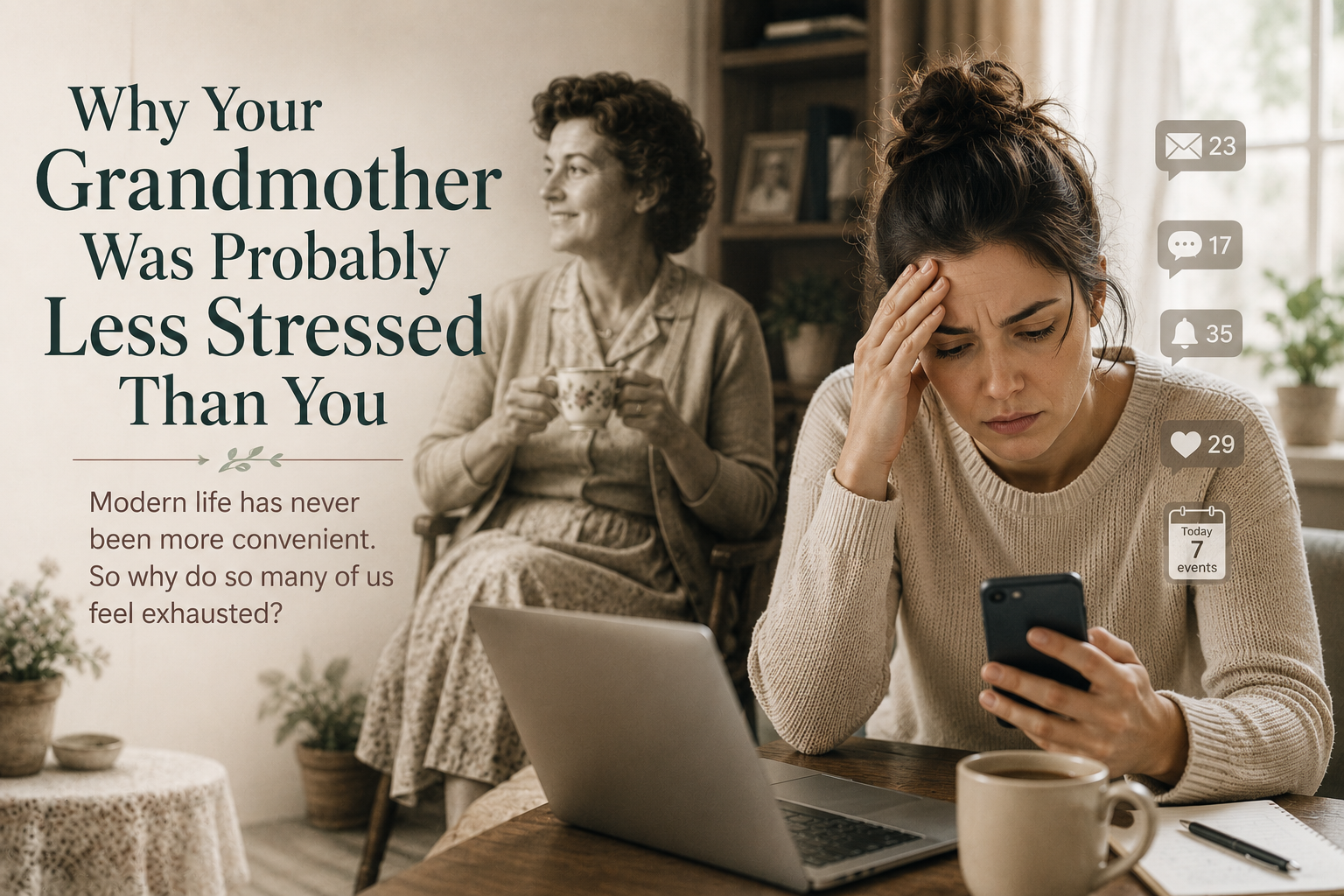
Modern life has never been more convenient. So why do so many of us feel exhausted?
Imagine taking your smartphone back in time and showing it to your grandmother when she was 30 years old.
You could explain that one device would allow her to:
- Talk to family members instantly.
- Order groceries without leaving the house.
- Watch any movie ever made.
- Access millions of books.
- Book holidays in minutes.
- Work from almost anywhere.
She would probably assume that people in the future must be happier, calmer, and less stressed than ever before.
After all, life would be easier.
Wouldn’t it?
Yet here we are.
More connected than any generation before us.
More productive than ever.
Surrounded by technology designed to save time.
And somehow many people feel permanently overwhelmed.
How did that happen?
The Great Paradox of Modern Life
For most of human history, daily life involved genuine physical challenges.
People walked more.
Household tasks took longer.
Communication was slower.
Finding information required effort.
Many aspects of life were undeniably harder.
Yet despite these difficulties, previous generations often experienced something many of us struggle to find today:
Mental space.
There were natural pauses built into life.
You waited for letters.
You waited for photographs to be developed.
You waited for shops to open.
You waited for television programmes to air.
Those pauses may have seemed inconvenient at the time, but they provided something valuable that is becoming increasingly rare.
Silence.
Today, silence has become optional.
And because it is optional, many of us never experience it.
We Were Never Designed to Consume This Much Information
Take a moment and think about what your brain processes before breakfast.
You might check:
- Emails
- News headlines
- Weather updates
- Social media posts
- Group chats
- School messages
- Work notifications
- Bank alerts
All before you’ve even had your first cup of tea.
A century ago, people would have struggled to access that much information in an entire week.
Our brains evolved to deal with immediate, local concerns.
Instead, we now carry the worries of the entire world in our pockets.
A political crisis thousands of miles away.
A celebrity scandal.
Economic forecasts.
Natural disasters.
Social media arguments.
Our nervous systems often react to these events even though we have no direct control over them.
The result is a constant low-level state of alertness.
The Hidden Burden of Endless Choice
Many people assume freedom always reduces stress.
In reality, too much choice can become exhausting.
Psychologists call this decision fatigue.
Your grandmother may have chosen between two breakfast options.
You choose between twenty.
She selected from a handful of television channels.
You scroll endlessly through thousands of programmes.
She compared prices in one local shop.
You compare hundreds of products across dozens of websites.
Choice feels empowering until it becomes overwhelming.
Modern life requires thousands of micro-decisions every day.
Each one consumes a tiny amount of mental energy.
By evening, many people feel exhausted without understanding why.
Social Comparison Has Become a Full-Time Job
For most of history, people compared themselves to a relatively small number of individuals.
Family members.
Neighbours.
Friends.
Colleagues.
Today we compare ourselves with thousands of people every week.
Often without realising it.
We see:
- Perfect kitchens.
- Perfect holidays.
- Perfect bodies.
- Perfect careers.
- Perfect relationships.
What we rarely see are the struggles behind those images.
The debt.
The arguments.
The anxiety.
The sleepless nights.
When we compare our real lives to somebody else’s carefully edited highlights, we almost always lose.
Not because our lives are worse.
Because the comparison itself is unfair.
We Have Become Addicted to Productivity
Somewhere along the way, many of us stopped measuring success by how we felt and started measuring it by how much we achieved.
Busy became a badge of honour.
Rest became something that had to be earned.
Doing nothing became uncomfortable.
Even our hobbies started becoming goals.
We don’t simply walk.
We track our steps.
We don’t simply read.
We set reading targets.
We don’t simply relax.
We optimise.
Measure.
Improve.
Analyse.
There is nothing wrong with ambition.
But human beings were never meant to operate like machines.
A life filled with constant optimisation can leave very little room for joy.
Why Children Often Understand Happiness Better Than Adults
Watch a young child at a park.
They are rarely thinking about next week’s meeting.
Or mortgage rates.
Or social media engagement.
They are fully present.
Adults often spend enormous amounts of time either worrying about the future or replaying the past.
Meanwhile, the present moment slips by unnoticed.
Many wellbeing experts argue that one of the greatest challenges of modern life is simply learning how to be where we already are.
Not next month.
Not next year.
Now.
The Things Previous Generations Got Right
It would be foolish to romanticise the past.
Previous generations faced significant challenges.
However, there are valuable lessons worth remembering.
Many older adults experienced:
- Stronger local communities.
- More face-to-face conversations.
- Clearer boundaries between work and home.
- More daily movement.
- Fewer digital distractions.
- More unstructured free time.
Interestingly, these are many of the same factors modern wellbeing research now identifies as important for mental health.
Perhaps progress is not only about adding more.
Sometimes it is about protecting what matters.
How to Feel Less Overwhelmed in a Hyperconnected World
You do not need to move to a remote village or throw away your smartphone.
Small changes can have surprisingly powerful effects.
Try:
Create Daily Quiet Time
Even ten minutes without notifications can help calm an overstimulated nervous system.
Stop Starting Every Day With Your Phone
Give your own thoughts a chance to appear before the world’s thoughts arrive.
Reduce Unnecessary Decisions
Simplify routines where possible.
Many successful people wear similar clothes every day for this reason.
Spend More Time Face to Face
Human connection remains one of the most powerful predictors of wellbeing.
Allow Yourself to Be Unproductive
Not every moment needs to be useful.
Some moments simply need to be lived.
Final Thoughts
Your grandmother probably wasn’t less stressed because her life was easier.
In many ways, it was harder.
She may have been less stressed because her attention wasn’t being pulled in a thousand different directions every day.
She wasn’t carrying the world’s news in her pocket.
She wasn’t comparing herself with strangers online.
She wasn’t receiving notifications while eating dinner.
Modern life offers extraordinary opportunities.
But it also demands something previous generations rarely had to manage: constant mental stimulation.
The challenge isn’t rejecting modern life.
It’s learning how to live in it without allowing it to consume us.
Sometimes the future of wellbeing doesn’t involve discovering something new.
Sometimes it involves remembering something old.