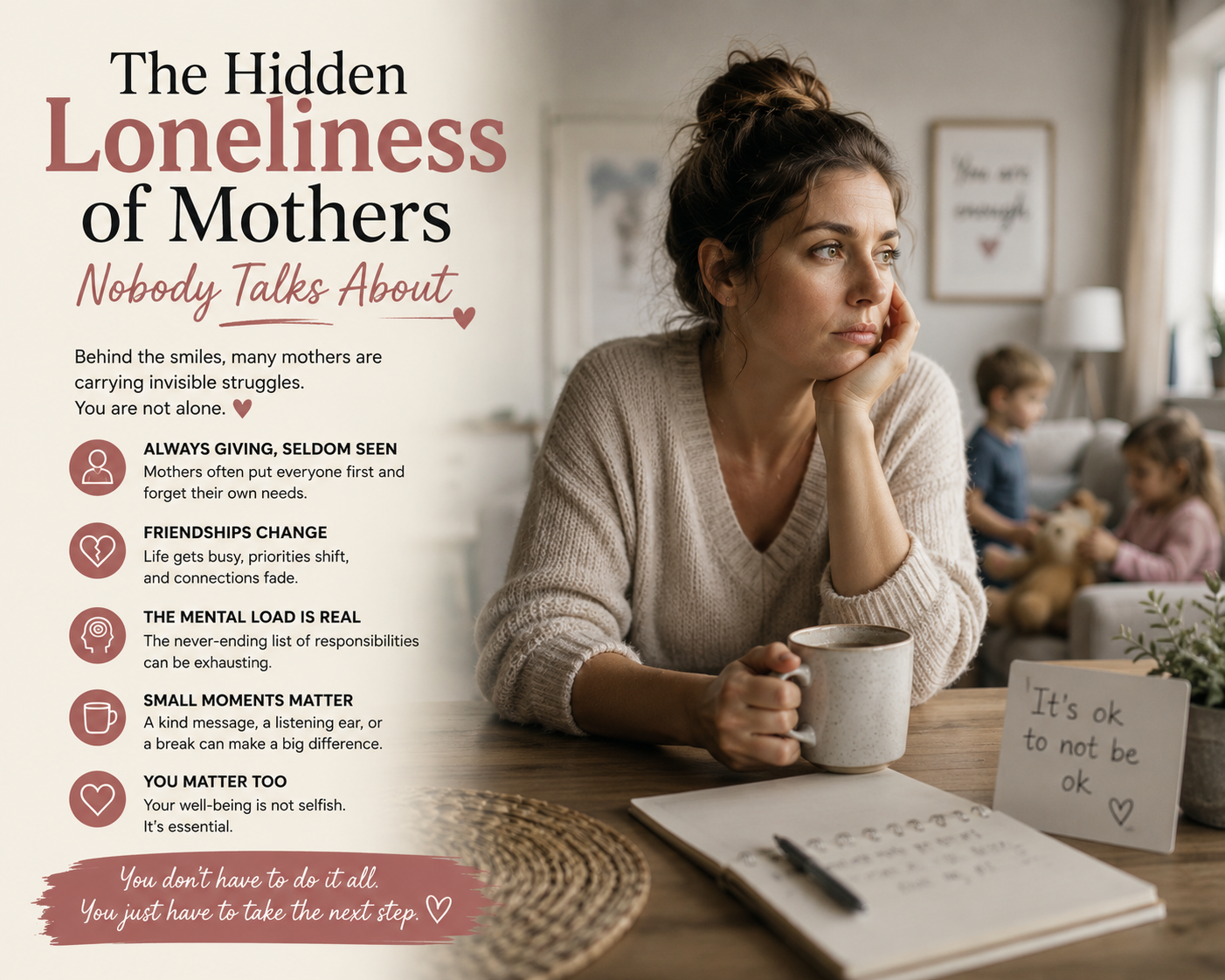
Motherhood is often described as one of life’s greatest joys.
And for many women, it truly is.
The first smile. The first steps. The tiny arms wrapped around your neck after a difficult day.
These moments are priceless.
But there is another side of motherhood that few people talk about openly.
A quiet loneliness that can exist even in a house full of people.
“I Am Never Alone, Yet I Feel Lonely”
Many mothers spend their days constantly surrounded by others.
Children need attention.
Partners need support.
Work responsibilities continue.
Family members call.
The house needs cleaning.
Meals need preparing.
Yet despite never having a moment to themselves, many mothers report feeling profoundly lonely.
Not because they lack people around them.
But because they lack people who truly see them.
The Disappearing Identity
Before becoming a mother, most women had identities that extended beyond caring for others.
They had hobbies.
Goals.
Friendships.
Dreams.
Passions.
After children arrive, much of that identity can slowly become overshadowed by a new role.
Suddenly, introductions begin with:
“She’s a mum.”
While motherhood is something to be proud of, many women quietly wonder:
“Who am I outside of being a mother?”
This question often brings guilt.
Yet it is a completely normal part of personal growth.
Why Friendships Often Change
One of the most unexpected challenges of motherhood is watching friendships evolve.
Friends without children may not understand the realities of parenting.
Mothers become busier.
Spontaneous coffee dates disappear.
Text messages take days to answer.
Slowly, some friendships fade.
It is rarely intentional.
But it can leave women feeling isolated during a period when support is needed most.
The Pressure to Be Perfect
Modern mothers face enormous expectations.
Be patient.
Be present.
Be healthy.
Be successful.
Keep the house clean.
Maintain relationships.
Stay fit.
Raise happy children.
And somehow make it all look effortless.
Social media often makes this pressure worse.
We see carefully selected photographs of smiling families and tidy homes.
What we rarely see are the tears, exhaustion, self-doubt, and sleepless nights behind those images.
The Mental Load Nobody Sees
Many mothers carry an invisible workload known as the mental load.
Remembering appointments.
Planning meals.
Buying birthday presents.
Scheduling activities.
Keeping track of school events.
Managing family routines.
The mental load is exhausting because it never truly switches off.
Even during moments of rest, the mind remains busy.
Over time, this constant responsibility can contribute to feelings of loneliness and overwhelm.
What Mothers Need Most
Surprisingly, many mothers are not asking for grand gestures.
They often need simple things:
Someone to ask how they are doing.
A genuine conversation.
A few hours to themselves without guilt.
A friend who understands.
Permission to admit that motherhood can be difficult.
Because loving your children and struggling with motherhood can exist at the same time.
The two are not opposites.
If You Are Feeling Lonely
If you are reading this and feeling lonely, know that you are not alone.
Millions of mothers experience these feelings.
It does not mean you are ungrateful.
It does not mean you are failing.
It does not mean you love your children any less.
It simply means you are human.
Reach out to another mother.
Join a local group.
Send the message.
Make the phone call.
Accept help when it is offered.
Small connections can make an enormous difference.
A Final Thought
Motherhood changes almost every part of life.
It transforms routines, priorities, relationships, and identity.
But amid all those changes, one thing remains important:
You matter too.
Not just as a mother.
Not just as a partner.
Not just as a caregiver.
But as a person.
And sometimes the most important thing a mother needs to hear is this:
You deserve care, support, and connection just as much as everyone else.